Community Learning
At Digital Unite, we offer structured yet flexible training programmes for groups and communities. The aim is to introduce digital technology to older and less confident technology users, and to give them the skills and confidence to carry on learning independently. We call this 'Community Learning'.
What is community learning?
Digital Unite Community Learning is a bespoke and practical group learning approach designed to introduce the world of digital technology to older and less confident technology users in local communities such as sheltered housing.
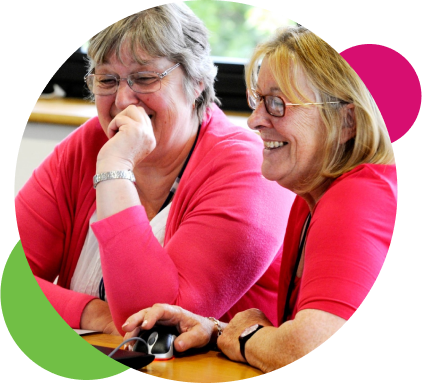
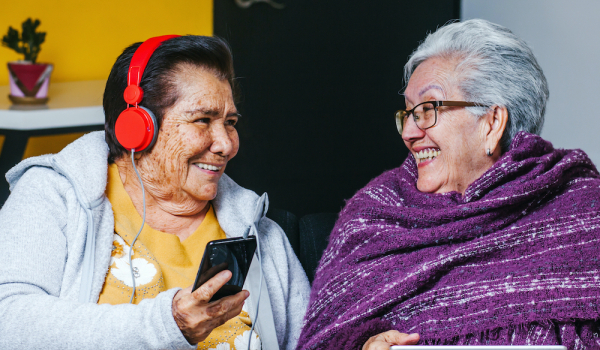
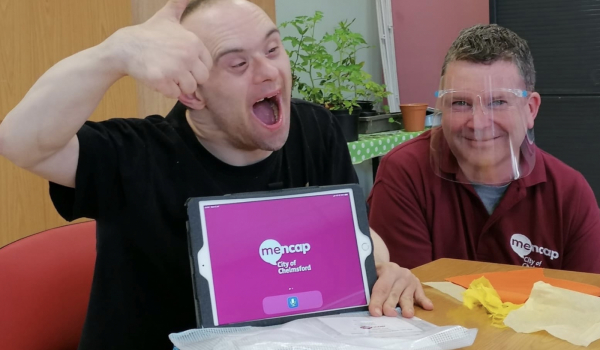
We teach a group of people, staff and residents, essential digital skills. As the group learns, they create a self-sustaining, self-teaching digital community. Our emphasis is on working with you to create a community that lasts and keeps on growing, long after the formal training has finished.
We have designed, evolved and refined the methodology over eight years as a result of our experience in successfully delivering the community learning methodology, most recently via the Get Digital project.
Our quality assured and experienced tutors provide empathetic and easy to understand tuition tailored to individual needs. The learning covers all essential digital areas from getting started on a pc and handling a mouse, to using Skype and webcams, browsing the internet or interacting with others via online forums and social networks.
Who is it for?
Anyone! We developed Digital Unite Community Learning specifically for sheltered housing residents but it works for all kinds of group. As it’s all about sharing and supporting others, it doesn’t matter if the group has mixed skill levels.
What are the benefits?
Digital inclusion including access to the internet and the skills to use it is no longer a nice-to-have, it’s a must have. Our Community Learning programme can bring multiple benefits to an organisation:
- Engaged tenants/service users who learn new skills, build a stronger support network and can overcome social isolation.
- Learning opportunities for paid and voluntary staff that give them the chance to thrive and develop in a stimulated and sustained environment.
- Recognition by your peers and local network as an innovative and forward thinking service provider.
- A practical and proven way to break down barriers and build relationships across your entire community.
How does it work?
Digital Unite Community Learning can be specifically tailored to the needs of your organisation.
We can engage with residents directly, equip scheme staff with the skills and knowledge they need to deliver their own digital teaching, or enhance the training skills of the central learning teams to support learning across your entire organisation.
The sessions are delivered on a face-to-face basis, are populated with practical exercises and are always tailored to individual needs, abilities and aspirations. All of our teaching is supported with ongoing advice and resources so that once started, the learning and digital awakening can continue for the months and years that follow.
Scheme staff
We can help scheme staff develop basic IT skills and digital awareness to deliver their own resident digital awareness activities. Initially staff would deliver courses alongside Digital Unite tutors and mentoring and learning support would be provided as required.
Central learning teams
We can provide your organisation’s training team with support, advice and learning material to enable them to run their own digital learning days and sustain the activity on a long-term basis. Staff would deliver courses alongside Digital Unite tutors and and mentoring and learning support would be provided as required.
Residents
Our resident teaching programme is made of up six key stages as described below. It can be structured, however you or your team choose, to create a bespoke programme.
- Be Prepared. An initial introduction session with all those involved in running the digital learning activity.
- Get Set Up / Get Enthused. This session covers the technical set up and provides an opener for residents and/or staff.
- Get Learning. This fundamental aspect of the programme covers a range of topics that are specifically tailored to individual learning needs, from basic skills such as using a mouse and searching on the web, to intermediate skills such as keeping in touch by Skype, creating cards and downloading digital pictures. Advanced skills include areas such as online shopping and banking, social networking, researching family histories and booking entertainment and holidays.
- Planning the Future. This session provides advice and support with developing action plans to sustain digital learning activities.
- Expert Supervision. This is effectively the handover of the initiative to the landlord or scheme.
Evaluation and Follow-up. We carry out a full evaluation and provide recommendations for the future.
Community Learning in action
Here a are a couple of examples of Community Learning in action:-
1. Testway Housing Association, part of the Aster Group, is the largest Landlord in the Test Valley area of Hampshire. It has 150 staff and approximately 6,000 residents.
In 2010 Digital Unite worked with Testway across three of its schemes to organise, manage and deliver digital learning activities as part of a national programme.
To get started in one scheme our tutor worked with the staff to support the technical set-up. He then met with the group of 16 learners to understand their previous experiences and aspirations, dispel any fears or misconceptions and build their confidence. The learners were paired up and given focused tuition relevant to their skills, needs and interests,
The group varied in terms of abilities and backgrounds. One learner was not new to IT and had his own laptop and one learner could not easily manage a mouse so was provided with a trackball.
With his newly acquired skills one learner decided to explore his ancestry. As a result of his research he discovered to his surprise that his great grandfather had been born on the Isle of Skye. This was a revelation to him. “All my life I have always wondered why I loved to hear bagpipes!”
Another learner was able to retrace his steps from many years back. He took a Greyhound Bus trip across the USA in his youth. Using Google Earth and Google Maps street view he revisited many places in a virtual way and revived some long-forgotten memories.
“We’ve been working with some of our older residents in Romsey for some time now. After just a few training sessions the residents took to internet surfing like ducks to water. The classes have proved so popular we wanted to continue and take it into our other schemes in the Test Valley. With the help of tutors from Digital Unite we’re now able to get more of our older residents online and the Wii Fit will help to keep them active.” Doreen Thomas, Lifestyle Promoter, Testway Housing Association
2. Get Digital was a 12 month programme funded by the Department for Work and Pensions and the Department for Communities and Local Government and delivered by Digital Unite in partnership with the National Institute of Adult Continuing Education (NIACE).
Between April 2010 and March 2011 we worked with residents, staff, landlords and the wider community to promote, develop and sustain digital literacy and awareness among residents in sheltered housing schemes. This was achieved, either through group learning tuition or by providing access to learning resources, guidance and support.
Over 500 schemes were supported with digital learning activities as a result of Get Digital and thousands of older people living in sheltered housing were helped to use computers and the internet for the first time.
The programme also helped landlords to build resident communities, facilitate business transformation and create opportunities to strengthen links with local organisations and networks.
To learn more about how the Get Digital programme helped both learners and schemes benefit from the world of computers and the internet visit the Get Digital website.
The tuition phase of Get Digital, delivered by Digital Unite, was successfully completed in March 2011 and a full evaluation report will be published by NIACE in autumn 2011.
The programme’s learning materials continue to be available to download via the Get Digital website. These materials allow many more sheltered housing schemes to replicate the group learning model and establish their own community programmes.